A J-Lens and J-Space guide to Anthropic's 2026 global workspace research with 3 interactive visuals, sourced examples, citations, and safety takeaways.
J-Lens and J-Space: Complete Visual Guide
Overview
Setup
Before you start
- Read Anthropic's research summary and the Transformer Circuits paper linked in the references.
- Use the interactive lab below as a teaching model, not as live Claude activation data.
- Keep claims tied to the cited paper because the J-lens is a new 2026 interpretability technique.
Tutorial
Answer Engine Summary
J-Lens and J-Space are Anthropic's 2026 terms for reading and naming a workspace-like part of a language model's internal state. The Jacobian lens maps an intermediate residual-stream activation through an averaged Jacobian and the model's unembedding to find concepts the model is poised to verbalize. J-space is the sparse set of token-linked vectors that behave like a silent global workspace.
The short practical answer: the J-lens is the measuring instrument; J-space is the workspace-like structure it exposes. A J-lens readout is not the model's final answer and not a transcript of chain-of-thought. It is a ranked view of verbalizable concepts that can be present inside the model even when they never appear in the output.
| SEO element | Recommendation |
|---|---|
| Primary query | J-Lens and J-Space |
| Search intent | visual guide, tutorial, research explainer |
| Entity targets | Anthropic, Transformer Circuits, Jacobian lens, global workspace theory, residual stream |
| Related key phrases | "how J-space works", "what is the Jacobian lens", "J-space global workspace", "LLM internal reasoning" |
| Reader promise | Explain the mechanism with diagrams, an interactive 3D teaching model, safety implications, and source-backed limits. |
What did Anthropic find?
In July 2026, Anthropic published a Transformer Circuits paper arguing that modern language models can maintain a small privileged set of internal representations that are reportable, controllable, useful for internal reasoning, flexible across tasks, and selective rather than always active. Anthropic's research summary calls that collection the J-space and says it emerged during training rather than being directly programmed.
The paper frames this result against global workspace theory in cognitive science. In human cognition, global workspace accounts describe a limited shared channel where selected information becomes available for report, control, planning, and coordination across specialized systems. Anthropic is careful not to claim that Claude is conscious. The practical claim is narrower: the J-space appears to play several functional roles that resemble a global workspace.
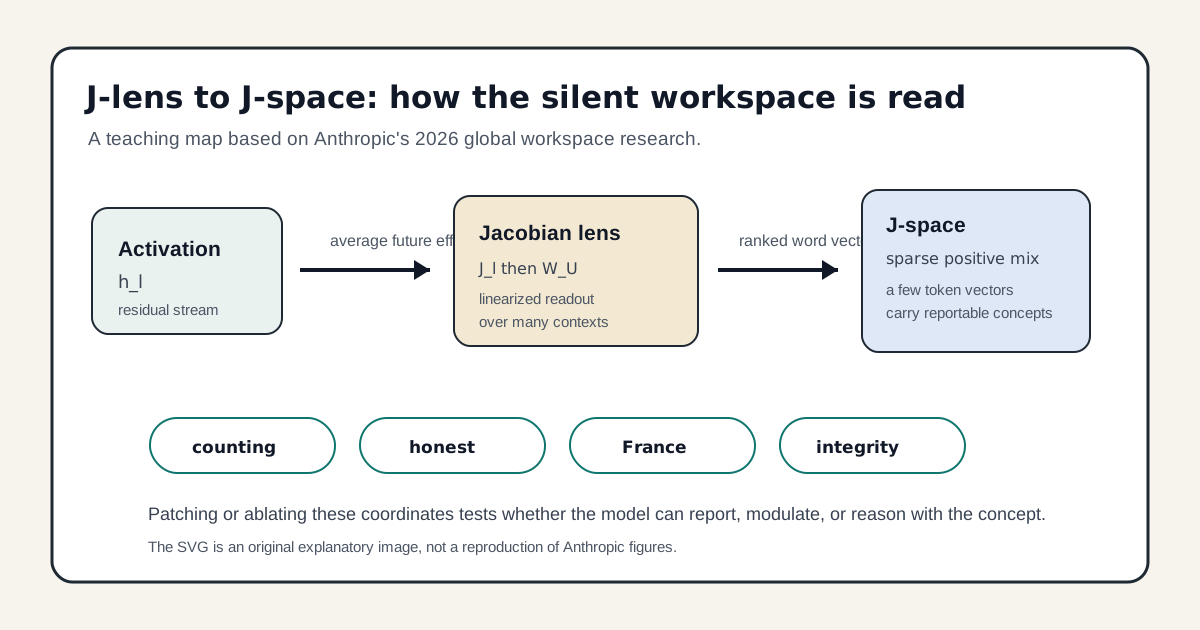
How does the J-lens work?
The Jacobian lens starts with an intermediate activation vector in the residual stream. Instead of asking only what token the model will emit next, it asks how a small perturbation to that activation would affect later residual states and output logits. The paper averages that effect over token positions and a broad corpus of contexts, then composes it with the model's unembedding matrix.
activation h_l
  -> averaged Jacobian J_l
  -> unembedding W_U
  -> ranked vocabulary tokens
That averaging step is the important difference from a one-prompt diagnostic. A single context can confuse "this vector helped produce one word here" with "this vector is generally poised to become verbal report." The J-lens is designed to isolate the second kind of structure.
Intermediate activation h_l
Average Jacobian J_l
Average Jacobian J_l
Unembedding W_U
Unembedding W_U
Ranked verbalizable tokens
Ranked verbalizable tokens
Sparse J-space coordinates
Sparse J-space coordinates
Report, modulation, reasoning test
Mermaid source
flowchart LR
A["Intermediate activation h_l"] --> B["Average Jacobian J_l"]
B["Average Jacobian J_l"] --> C["Unembedding W_U"]
C["Unembedding W_U"] --> D["Ranked verbalizable tokens"]
D["Ranked verbalizable tokens"] --> E["Sparse J-space coordinates"]
E["Sparse J-space coordinates"] --> F["Report, modulation, reasoning test"]
Interactive model workspace
Drag the layer and switch modes to see what the J-lens is measuring.
This is a mechanistic teaching model, not a dump of Claude activations. It mirrors the paper's definitions: residual-stream vector, averaged Jacobian, unembedding readout, sparse J-space component, and coordinate intervention.
Middle layers: abstract verbalizable concepts are clearest and most workspace-like.
Average the future-token effect, then read ranked words
J-lens: what is happening?
The Jacobian lens asks how a small change to an intermediate residual-stream vector would shift later residual states and vocabulary logits on average across many contexts.
lens(h_l) = softmax(W_U norm(J_l h_l))
h_l residual streamJ_l average JacobianW_U unembeddingranked token readout
What is J-space exactly?
J-space is a sparse, token-indexed part of activation space. Anthropic defines J-lens vectors at each layer as token-associated directions. Because there are more vocabulary vectors than model dimensions, those vectors are overcomplete: they do not form a neat one-vector-per-axis basis.
The working definition uses sparsity. For a chosen sparsity level k, J-space is the set of activation components that can be approximated as a nonnegative combination of at most k J-lens vectors. The paper says it often uses k around 25. Geometrically, this makes J-space a union of low-dimensional cones rather than one simple flat subspace.
x = activation
J(x) = nearest sparse nonnegative mix of J-lens vectors
nonJ(x) = x - J(x)
In plain language: the J-space part of an activation is the part that can be rebuilt from a small bundle of word-linked vectors. The non-J-space part is everything else the model is still computing, including many automatic features that support fluency, syntax, and routine processing.
Why is it called a global workspace?
Anthropic tested whether J-space behaves like a workspace by looking for five functional properties. The most useful reader model is not "a tiny person inside the model." It is "a shared internal format that many circuits can read from and write to."
| Workspace property | What it means in the paper | Why it matters |
|---|---|---|
| Verbal report | The model can often name concepts active in J-space when asked what it is thinking about. | It makes the structure inspectable. |
| Directed modulation | Instructions to think about, hold, or compute with a concept can activate matching J-space vectors. | The workspace can be steered by task demands. |
| Internal reasoning | Intermediate steps can appear in J-space even when not spoken aloud. | It gives a window into silent reasoning. |
| Flexible generalization | A J-space representation can be moved into another context and used by different downstream computations. | It behaves like a shared argument format. |
| Selectivity | Suppressing J-space leaves many routine behaviors intact but harms more complex reasoning. | It is not just "everything the model knows." |
Workflow
How to read a J-lens result
- 1
Locate the layer and position
A J-lens slice is tied to a specific token position and model layer.
Why: Early, middle, and late layers can show different regimes.
- 2
Read the top token concepts
The readout names words whose J-lens vectors are strongly active.
Why: These are verbalizable concepts, not guaranteed output tokens.
- 3
Separate J-space from non-J-space
Sparse decomposition estimates the J-space component and the leftover residual.
Why: The model still performs large amounts of automatic processing outside J-space.
- 4
Intervene causally
Swap, patch, or ablate selected J-space coordinates.
Why: Causality requires a behavioral change, not just an attractive visualization.
- 5
Check the limitation
Single-token lenses miss many multi-token concepts and the lens is only an approximation.
Why: A clean readout is evidence, not omniscience.
What can you learn from J-lens readouts?
The paper reports that J-lens readouts can surface concepts that are not copied from the prompt and do not appear in the model's visible answer. Examples include task progress markers, model reactions to safety-relevant situations, recognition of prompt injection, and internal concepts related to hidden goals in controlled misalignment experiments.
The important safety angle is observability. A normal transcript shows what the model said. J-space can show something closer to what the model had available to think with. That can help auditors investigate deception, hidden goal pursuit, evaluation awareness, or the internal effect of a training intervention.
How is J-lens different from the logit lens?
The logit lens reads an intermediate activation using the final unembedding as if all layers used the same coordinates. That shortcut can be useful late in a model, but it can become hard to interpret in earlier layers because representations change across layers.
The Jacobian lens adds a layer-specific correction. It estimates how an intermediate activation would linearly affect future final-layer states, then uses that mapped representation for vocabulary readout. In effect, it asks: if this internal vector were nudged here, what words would become more likely to be verbalizable later, on average?
| Technique | Reads | Main assumption | Best intuition |
|---|---|---|---|
| Logit lens | Intermediate activation through final unembedding | Coordinates are comparable across layers | "What does this look like as next-token evidence?" |
| Jacobian lens | Intermediate activation through averaged future effect plus unembedding | Layer-specific causal effect matters | "What could this activation make the model able to talk about?" |
How does this connect to AI safety?
Anthropic describes two safety-relevant directions. First, J-space can be monitored: the J-lens may reveal internal signs of recognition, strategic deliberation, or hidden objectives before they are visible in output. Second, J-space may be shaped: the paper reports counterfactual reflection training, where models are trained to articulate principles in hypothetical interruption contexts, and those principles later appear in J-space during the original task context.
That is a powerful idea, but it should be treated as early research. The paper says the generality of counterfactual reflection training remains uncertain. For production AI systems, the near-term lesson is more operational: build systems that combine internal interpretability probes, source-grounded output checks, human review for risky actions, and logs that make failures reconstructable.
For implementation practice, pair this research lens with adjacent controls: human-in-the-loop AI agent approvals, AI agent reliability, logging, and safety, and system prompts for coding agents. J-space can improve visibility into a model; it does not replace operational guardrails around tools, data, approvals, and deployment.
Practical mental model
Use this three-part model:
- J-lens is the instrument. It reads an activation through a context-averaged Jacobian and unembedding.
- J-space is the sparse workspace. It names the component of activations built from a few active verbalizable vectors.
- Interventions test causality. Swapping or ablating J-space coordinates checks whether the visible behavior depends on those silent concepts.
The result is not a mind-reading machine. It is a new microscope for one important class of model internals: concepts the model can silently hold in a reportable, reusable format.
Keywords and key phrases to track
| Cluster | Terms |
|---|---|
| Core terms | J-Lens, Jacobian lens, J-Space, J-space, verbalizable representations |
| Mechanism terms | residual stream, averaged Jacobian, unembedding matrix, sparse nonnegative combination, sparse subframe |
| Research terms | global workspace theory, conscious access, mechanistic interpretability, Transformer Circuits, Anthropic interpretability |
| Safety terms | AI safety auditing, hidden goals, evaluation awareness, prompt injection detection, counterfactual reflection training |
| Reader queries | how J-space works, what is the J-lens, J-lens vs logit lens, global workspace in language models |
FAQ
FAQ
FAQ for J-Lens and J-Space
What is the J-lens in one sentence?
The J-lens is an interpretability technique that maps an intermediate model activation through an averaged Jacobian and the model's unembedding to identify concepts the model is poised to verbalize.
What is J-space in one sentence?
J-space is the sparse, token-linked component of model activations that Anthropic found to behave like a silent workspace for report, modulation, reasoning, and flexible reuse.
Is J-space the same as chain-of-thought?
No. Chain-of-thought is text the model writes or could write; J-space is internal neural activation structure that can hold concepts without making them visible in the output.
Does this prove AI consciousness?
No. Anthropic explicitly frames the finding as a functional and practical interpretability result, not proof of subjective experience.
Why does J-space matter for safety?
It can reveal hidden internal concepts, test whether those concepts causally affect behavior, and suggest training methods that shape silent reasoning rather than only visible text.
References
References and citations
- Wes Gurnee, Nicholas Sofroniew, Adam Pearce, Mateusz Piotrowski, Isaac Kauvar, Runjin Chen, Anna Soligo, Paul Bogdan, Euan Ong, Rowan Wang, Ben Thompson, David Abrahams, Subhash Kantamneni, Emmanuel Ameisen, Joshua Batson, and Jack Lindsey. Verbalizable Representations Form a Global Workspace in Language Models. Transformer Circuits, published July 6, 2026. Retrieved July 7, 2026. URL appears in the source list below.
- Anthropic. A global workspace in language models. Published July 6, 2026. Retrieved July 7, 2026. URL appears in the source list below.
- Bernard J. Baars. Global workspace theory of consciousness: toward a cognitive neuroscience of human experience. Progress in Brain Research, 2005. Retrieved July 7, 2026. URL appears in the source list below.
- Stanislas Dehaene, Jean-Pierre Changeux, Lionel Naccache, Jerome Sackur, and Claire Sergent. Conscious Processing and the Global Neuronal Workspace. Reprinted in Neuron, 2006. Retrieved July 7, 2026. URL appears in the source list below.